top of page

Sheltering Walls

Bare Trees in Fog

The Saturday Farmer's Market right outside my apartment in Berlin brings people from the neighborhood together in a spirit of "joie de vivre". The cafe lined street with choice ethnic restaurants is a mecca any day of the week. People here are living the "good life". A young woman with arm outsretched standing inside her "strudel stall" tempted me with her home-baked delight. Of course, I couldn't resist spending four euros to have a slice of Germany's version of apple pie. She couldn't resist asking "Where are you from?" that ubiquitous question after hearing my "guten Morgan" and "Danke Schoen", a dead giveaway. I followed up with this bright-eyed woman the age of my daughter, who was then celebrating her 32nd birthday this very day in the States. I asked, "Are you from Berlin?" She pointed to the place where she was standing and said she had grown up "right here, on this street." I asked "Has it changed much?" "Oh yes! All the buildings used to be gray. There was nothing here before the wall came down. My parents have a picture of me when I was four years old on my bike and there were only three cars on the street." She understood that I was a transient passing through her world that had seen so much change in her short lifetime. There was no way for outsiders to understand this painful legacy that has risen up from the ashes like a phoenix. Yet, the markers are everywhere in the many monuments that overpower the landscape.


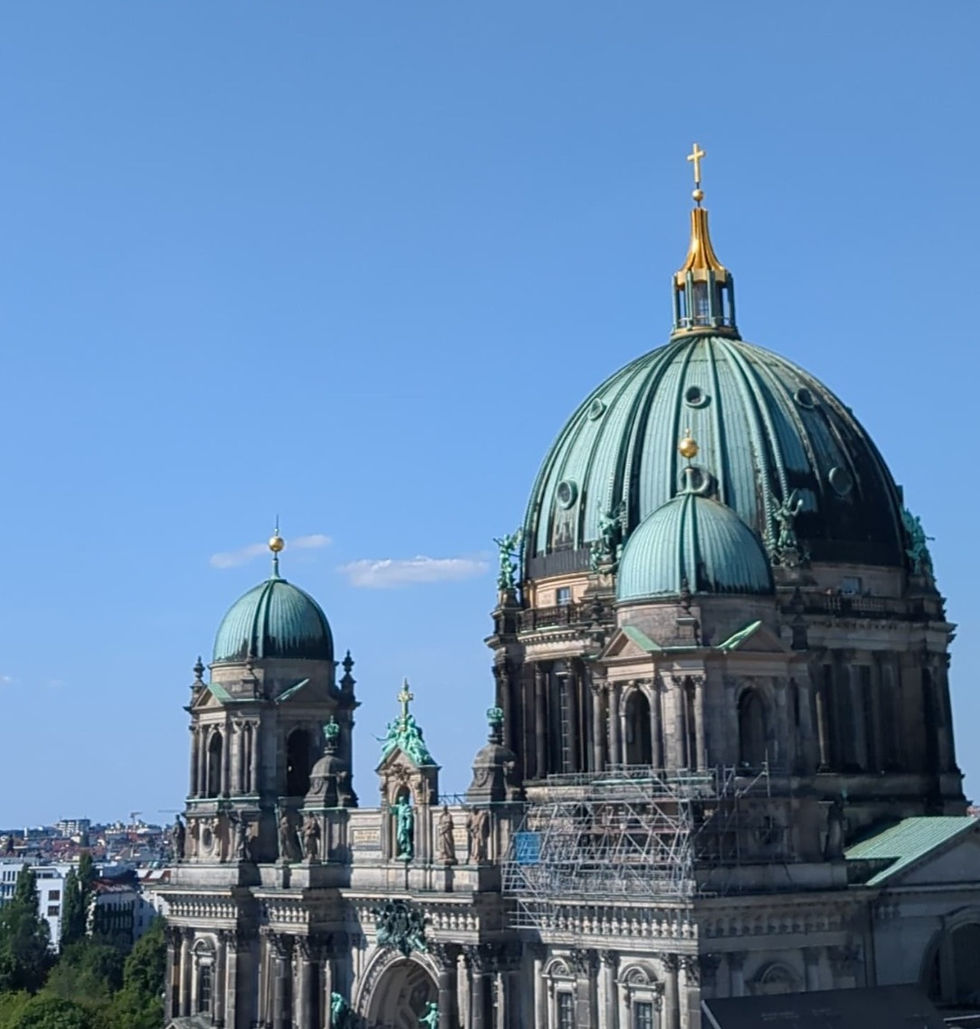
For a place that was bombed out, the past still stands, in part because the zoning laws of "reunification" construction, that continues thirty-four years after the wall came down, calls for old facades to be maintained wherever possible. This creates an unusual dichotomy both architecturally and symbolically, especially if the original place itself symbolized the worst oppressors: men who controlled the populace through sheer willpower going back centuries. One of the most recently opened (twenty years in the making) is the former City Palace renamed the Humboldt Forum after the geographer and explorer, Alexander von Humboldt. The outside was maintained right up to its gold cross atop the dome that can be seen for miles. Not all Berliners agreed with the choice to allow the former Prussian kingdom's wealth, never shared with the people, to be restored to its opulence as a showpiece monument. To counteract this choice, the gutted palace has become museum space housing collections acquired from around the world. Talk about adding insult to injury! Nobody denies the controversial nature of such choices. The "forum" is meant to be a culturally diverse place for open discussion and debate. Some call it part of the healing that needs to happen here. I hope it will function in some way that does more than glitz over the real damage that was done to innocent people. I cannot help but think about the monuments in my own backyard that have been lightning rods rather than soothing balms.


Most recently in St Augustine, Florida, the city government voted to remove from the central plaza a monument that had stood in that place for decades. It was commissioned long ago by the Confederate mothers in honor of their fallen sons in the Civil War. The proposed removal prompted fury by some and delight by others. The monument was a symbol of all that the South had fought and died for, namely, slavery and its preservation. The plaza itself is no more than a small rectangular piece of geography that has its own violent history. Reverend Martin Luther King and local black people walked peacefully through the square after King called St. Augustine "The most racist city in America." He was jailed when he sat at a local lunch counter. Years later, the Mayor of Atlanta, Andrew Young, followed in those footsteps and was severely beaten in the plaza. The monument was standing tall through it all. It is not a stretch of the imagination to think who might have perpetrated the violence against these black men years after that monument was placed there. When it was decided to take it from there and relocate it outside the historic district, threats of violence were hurled once again. The weeks-long dismantling required tight security. Those monument movers were called from other Southern states where monuments had been removed to do the same dangerous work where I lived. Their lives were threatened. In the end, the monument was moved under cover of night by boat on the river rather than through the city streets in order to protect the movers.


The choices to move a monument from view or to reconstruct a monument to its glory are flip sides of the same coin. It makes me wonder about the deeper intrinsic value we have placed on these stone symbols. Why do we feel so viscerally attached or disgusted by them? Why do we step outside our comfort zone to support or protest the outcome of a choice made long ago by others? Every country has its monuments, like its own version of apple pie. It says something about pride of nationality and country to share your strudel with a foreigner. Is the choice to save a monument so important or, is it as simple as apple pie?



Updated: Jul 10, 2023

Today is not just Tuesday - it is the Fourth of July in my homeland. A day to celebrate FREEDOM from oppressors dating back to the adoption of the Declaration of Independence in 1776. Here in Berlin, in 1791, the Brandenburg Gate was completed as a symbol of peace. Later it was trapped behind the Berlin Wall like the people that Wall was meant to contain and control. . . until it didn't.


Yesterday I stood beneath the magnificent and massive gate which is adjacent to the U.S. embassy flying its red, white, and blue flag. The juxtaposition of these two symbols of freedom gave me pause. I felt linked to a story I did not live, but had grown up hearing and reading about. I couldn't help but think of the parallels with stories of oppression being written today in my own country. How Berlin came to its own ugly, not so distant past, so far from its monument to peace and freedom provides a cautionary tale for us.


Old and new friends in England, spoke about the precariousness of the States today, like a see-saw that could tip either way. I imagine that was true for Germany as it teetered between freedom and oppression: The people voted for Hitler! The rest, as they say is History and a very dark story that exists with its many scars on the landscape in the Holocaust Memorial; the violin music played daily in the Tiergarten (think Central Park) to remember the genocid ases; the remnants of a Wall torn down after forty years, by people like you and me.


Today is not just Tuesday - It is the Fourth of July, a day celebrating FREEDOM from oppressors! Yet, today in the midst of celebrating, there are bans against reading many books; bans against making private choices; bans against dressing as one wishes; bans against voting without fear; and, the worst oppression of all, fear to speak one's mind openly in public spaces which feels to me like a ban. I recently read that authoritarians want people to self-censor. That is totally anathema to OUR Constitution celebrated today across the United States: "We hold these truth to be self-evident, that all are created equal, that they are endowed, by their Creator, with certain unalienable rights, that among these are life, liberty, and the pursuit of happiness."


Here, in Germany, both Hitler and the Wall failed, but at a very high cost to life, liberty and happiness. Both crumbled because the peoples' will and spirit resisted oppression. The will of resistance proved to be more powerful than the MEN who forced their own wills on others. Without a doubt, this was the best outcome in the end. But the slippery slope to oppression should be avoided at all times by those of us who know better, i.e., "We the people . . ." you and me together, friends. We must not be afraid to speak truth to power. Not now, not ever!


Updated: Jun 30, 2023

Today is day 14 of an international trip, the first trip outside the US in 4 years! Like most of you, I stayed put during COVID. I definitely felt more trepidation about this trip than for my solo pilgrimage, B.C. (Before Covid), knowing the travel skills are a bit rusty overall.

It doesn't bring out my best side when well organized plans show even the smallest threads of unravelling. To mitigate any and I imagine (wrongly) all possible missteps, I printed out every document ahead of the trip and placed them together, in order, in a red folder. I was prepared for every contingency! Except for the ones that actually happened in real time.


"That's travel" is a familiar refrain among seasoned travelers, a kind of mantra, if you will, to repeat when you're breathless from running a mile from gate to gate with at least one unwieldy bag. In those moments no well thought out plan printed on paper in a red folder can help. The ONLY thing that will help in such situations is not oneself, but how someone else, a stranger, reacts to your plight. Several strangers at the Norwich regional airport, about the size of the St. Augustine airport near my home in Florida, showed their best side under pressure. They didn't have to help because I was late getting to the security line and we all knew it! Blame it on the last minute discovery that a tax had to be paid ahead of entering the security lane, unbeknownst to me, or, on the last minute coffee that I sat

sipping leisurely without taking note of the time. Both happened to be true and nearly caused a missed flight that would not go out again until the following day, while those prepaid tickets to the Van Gogh Museum and Concertgebeouw Orchestra in Amsterdam would have remained in the red folder, unused. Both were a longheld dream about to come true, if only I got on that plane revving its engines on the tarmac...waiting for me!


The security personnel stuck to their safety rules as they communicated the status of what was playing out inside the airport to the ground crew. My bag tripped the alarm. "Please open this," as I was asked about a possible laptop inside. "No" but, yes, a tablet was in there. Back through the scanner, again tripping the alarm. "Is there a keyboard in here?" I had repacked it from the larger checked back and forgotten about it. As I waited, the man on the other end of the walkie talkie appeared inside. "Why didn't you come through security earlier?" he asked. I started to explain, but I knew it was pointless. "You're going to miss it", he said, politely. "Is there another flight?" "Not today," he said. I thought it was over. Next thing I knew my bag was handed over and he said: "Gate 4, no I mean 3. Hurry, they're waiting for you." I ran all the way to the staircase butted up to the plane and saw a flight attendant waving me up to the door. He smiled, pointing to the passport sticking out of my bag, and said: "Welcome aboard."


Both the museum and the concert were well worth the hassle. I witnessed many times over these last two weeks people helping people in train stations, such as a solo woman helping the young mother on her own with a baby to get her luggage on and off board; in subways when I was repeatedly offered a seat by young people, and on the street when directions were given for no reason other than to help. We on the microlevel, (if not reportedly on the macro level) are kindhearted people ready to offer help to strangers. To experience this firsthand, as a stranger in strange lands, restores my faith in human kind!


Maybe you too know what I mean and have had your own experiences of either helping or being helped by someone out of kindness. I will hold on to this the next time I find myself quickly dismissing another person as "other" based on political positions. Perhaps some of those people in the airport, the train station and on the street would never agree with my viewpoint, but as strangers we saw only our mutual need for a positive outcome. I take this to heart as I go forward for the next 40 days.


bottom of page